
You are about to commit tens of thousands of dollars to a laptop backpack order, and the decision will come down to a sample you will hold for exactly three minutes. That is the uncomfortable reality of B2B sourcing — and the reason so many buyers walk away from factory visits with more questions than answers. What should you actually check? What separates a supplier that ships consistent quality from one that delivers a beautiful first sample and a disappointing first container?
This guide walks you through the sourcing journey for custom laptop backpacks: what premium manufacturing really looks like, how to evaluate a factory, and how to scale from one sample to a full production order without turning your project into a gamble.
Step One: Define the Backpack Your Market Will Actually Buy
Before you compare factories, define the product with brutal honesty. Laptop backpacks live and die on three things: protection, comfort, and perceived value. A padded 15.6-inch compartment is table stakes; the real differentiators are the details — water-resistant zippers, breathable back panels, reinforced shoulder straps, organized pockets that fit modern tech carry. Premium buyers can feel these differences within seconds of lifting the bag.
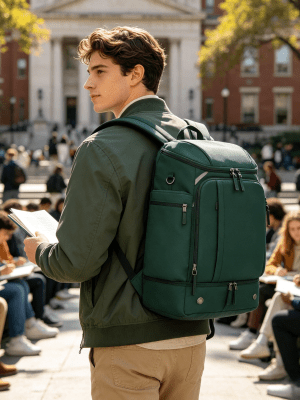
SimiBag’s laptop backpack line demonstrates how deep this category runs: from sleek urban silhouettes like the A2218 and A2308 to updated 2026 designs engineered for the modern remote workforce. Each model is a production-proven platform that you can customize with your branding, your fabric choices, and your hardware specifications — turning months of development into weeks.

Step Two: Stress-Test the Sample Like a Retail Customer
When that sample arrives, do not admire it — abuse it. Load it with a real laptop and a day’s worth of gear. Check how the zippers run a hundred times, not once. Press the back panel and ask whether the foam will survive a year of daily commuting. Pull the straps and look for stitching that puckers under tension. A premium sample should feel engineered, not merely assembled.
Then test the factory’s honesty. Ask what they would change about their own sample. A confident manufacturer points out weaknesses before you find them, because they would rather lose a sample order than ship a reputation-damaging production run. That candor is worth more than any certificate on the wall.
Step Three: Scale With Systems, Not Wishes
Scaling from sample to container is where supplier quality reveals itself. Ask about production capacity, quality inspection checkpoints, and how they handle fabric lot variations. A mature factory like SimiBag runs structured workflows: pre-production samples, inline checks during sewing, and final inspection before packing. That structure is what turns a good sample into ten thousand consistent units.
Delivery reliability matters just as much. Late shipments silently destroy margins and retail relationships. Confirm lead times in writing, build in buffer, and track communication discipline during quoting — it is the most accurate forecast of what production communication will feel like.
The Bottom Line
A laptop backpack is not a commodity; it is a first impression your customers carry on their backs every day. Source it with the same rigor you apply to your product design. Choose a factory that proves its quality in the sample, its systems in the process, and its honesty in the conversation — and scaling becomes a routine, not a risk.
Share this guide with any founder who thinks a backpack is “just a bag.” The question I will leave you with: can you afford to learn your supplier’s weaknesses after the first container, or before it?
Explore SimiBag’s laptop backpack collection and request your custom sample at simibag.com.
#LaptopBackpack #B2BSourcing #CustomBackpack #OEMBackpack #BuyersGuide