How does a thin plastic bag turn a fluffy winter jacket into a flat pancake? The science behind vacuum compression bags is surprisingly elegant — and understanding it helps buyers make better sourcing decisions.
The Basic Principle
A vacuum compression bag removes the air trapped between fabric fibers, reducing the volume of the contents by up to 80%. The bag itself does not compress anything — it simply creates an airtight seal and provides a path for air to escape.
The Film Structure
Vacuum bags are made from a composite film of two materials bonded together:
| Layer | Material | Function |
|---|---|---|
| Outer | PA (Polyamide / Nylon) | Strength, puncture resistance, oxygen barrier |
| Inner | TPU (Thermoplastic Polyurethane) | Heat-sealable, flexible at low temperatures |
How the Valve Works
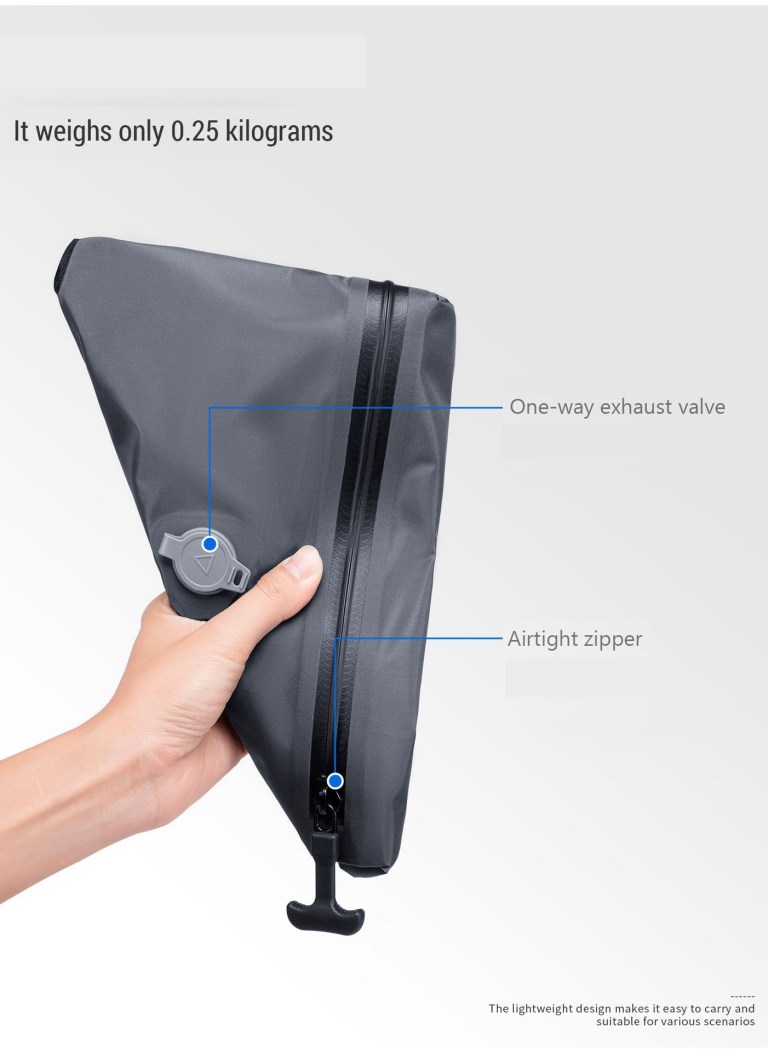
The valve is a one-way silicone membrane. When you apply suction (via vacuum cleaner, pump, or hand-rolling), the valve opens inward, allowing air to exit. When suction stops, the membrane snaps shut, preventing air from re-entering.
- Vacuum cleaner valve: Large opening, fast deflation, requires a vacuum hose
- Hand-pump valve: Smaller opening, slower but portable, compatible with manual or electric pumps
- Roll-to-compress valve: No external tool needed — roll the bag from the bottom to push air out through the valve, then seal
Why Triple-Seal Matters
A single-layer valve can fail after repeated use. Triple-seal valves have three concentric sealing rings — if one layer degrades, the remaining two maintain the seal. For branded retail products, triple-seal is the quality benchmark.
What Affects Compression Performance
- Fabric type: Down and polyester compress best. Cotton and denim retain more air.
- Film thickness: Thicker film holds vacuum longer but is less flexible.
- Temperature: Cold temperatures stiffen the film and can reduce seal effectiveness.
- Altitude: Bags compressed at high altitude may expand during air travel.
The Science Behind Vacuum Compression: One-Way Valve + Airtight Seal + Atmospheric Pressure
Vacuum compression relies on three interdependent mechanisms working together. Understanding these principles helps buyers evaluate product quality and communicate value to end customers:
1. One-Way Valve Mechanism
The valve contains a thin silicone membrane with a spring-loaded or pressure-activated flap. When external suction is applied (by pump, vacuum hose, or manual rolling), the pressure difference forces the flap open — air exits through the valve channel. When suction stops, the flap snaps back into its sealed position, blocking air from re-entering. The quality of the valve directly determines how long the vacuum holds. Premium valves use dual-layer or triple-seal silicone membranes that maintain integrity for 12+ months versus budget valves that may lose seal effectiveness after 3–6 months.
2. Airtight Seal Design
The bag’s closure system — typically a zip-lock track plus a secondary press-seal channel — creates a gas-tight barrier. The seal must withstand the outward pressure from the compressed contents (which can reach 0.5–0.8 atm in a fully compressed bag). Triple-track seals with interlocking ridges offer the highest reliability. The seal area should be at least 8–10 mm wide for adequate grip; narrower seals are prone to micro-gaps that slowly leak air over weeks.
3. Atmospheric Pressure
Once air is removed from inside the bag, the external atmospheric pressure (approximately 14.7 psi at sea level) presses down on the bag walls, holding the contents in a compressed state. This is why vacuum bags work at any altitude — though the compression ratio decreases slightly at higher altitudes where atmospheric pressure is lower. At sea level, the pressure differential can reduce volume by up to 75–80%; at 3,000 meters elevation, the reduction drops to about 60–65%.
Why Material Matters: The Impact of Film Composition on Airtightness
Different film materials have vastly different gas barrier properties, which directly affects how long a vacuum bag maintains compression:
| Material | Oxygen Permeability (cc/m²/24h) | Air Retention Duration | Suitability |
|---|---|---|---|
| Single-layer PE | 3,000–5,000 | 2–4 weeks | Short-term use only; air leaks through microscopic pores |
| PA+PE composite | 50–150 | 2–6 months | Good for travel; standard economy bags |
| PA+TPU composite (0.10 mm) | 15–40 | 6–12 months | Excellent; premium retail bags |
| PA+TPU composite (0.15 mm) | 5–20 | 12–24 months | Best-in-class; commercial/long-term storage |
The key takeaway: PA (nylon) acts as the oxygen barrier layer, while PE or TPU provides heat-sealability. Without a PA layer, a vacuum bag will lose compression within weeks regardless of valve quality. For B2B buyers specifying products for long-term storage (seasonal clothing, bedding), PA+TPU at 0.12 mm+ is the minimum recommended specification.
Common Usage Misconceptions — Corrected
Misunderstandings about vacuum compression bags often lead to poor user experiences and unnecessary returns. Here are the most common mistakes and how to address them:
- Misconception: “The bag is leaking — it’s defective.” Reality: Partial re-inflation after 24–48 hours is normal for PA+PE bags. The film has a measurable gas transmission rate. Only rapid deflation (within hours) indicates a genuine seal or valve defect. Educate customers that some expansion over time is expected, not a product failure.
- Misconception: “I can store a vacuum bag indefinitely.” Reality: Even premium bags lose compression over months. For seasonal storage (3–6 months), standard PA+PE bags are adequate. For long-term storage (6+ months), use PA+TPU bags and check compression monthly.
- Misconception: “Vacuum bags ruin my clothes.” Reality: Vacuum compression does not damage fabric fibers when used correctly. The risk is creasing — certain fabrics (linen, silk, wool suits) may develop permanent creases under prolonged compression. For these fabrics, recommend shorter storage periods (under 1 month) or using tissue paper between folds.
- Misconception: “More suction = better compression.” Reality: Over-vacuuming with industrial-strength equipment can stress the bag seams. Consumer-grade vacuum cleaners and hand pumps deliver the optimal pressure differential. Excessive suction can also damage delicate items like down jackets by forcing out the insulating loft permanently.
- Misconception: “All vacuum bags are the same.” Reality: Film thickness, valve quality, seal design, and material composition create wide quality variance. A $2 bag and a $15 bag may look identical on the shelf but differ by 10x in air retention duration. B2B buyers should request air retention test data when evaluating suppliers.
SIMIBAG produces vacuum compression bags with triple-seal valves and premium PA+TPU film. Contact us for technical specifications.
Published by SIMIBAG. Updated June 2026.
About SimiBag:
SimiBag is a backpack OEM/ODM manufacturer based in Guangzhou, China.
Since 2017, we have been producing custom backpacks, laptop bags, and
vacuum compression vaults for global B2B buyers.
Visit https://simibag.com for more information.