How to Choose Vacuum Storage Bags for Travel
If you travel frequently — or sell to people who do — you already know the problem: no matter how carefully you pack, your suitcase never seems big enough. Vacuum storage bags for travel solve this by removing excess air from clothing, reducing volume by up to 80%.
But not all vacuum storage bags are the same. Some require a pump, some don’t. Some are single-use, others last for years. And for brands looking to source their own line of travel vacuum bags, understanding these differences is the difference between a product that sells and one that gets returned.
This guide covers everything you need to know about how to choose vacuum storage bags for travel — from material types to valve design to the features that matter most for modern travelers.
Why Vacuum Storage Bags Matter for Travel
The core benefit is simple: compression. A standard packing method leaves air trapped between layers of clothing. Vacuum bags extract that air, turning bulky sweaters and jackets into thin, flat packs that stack neatly inside luggage.
For carry-on travelers (typically 35–45 liter bags), vacuum compression can mean fitting 5–7 days of clothing into a space that would normally hold 3–4 days. For checked-baggage travelers, it means room for souvenirs. For brands, it means a product category with near-universal appeal — from business travelers to backpackers to family vacationers.
According to industry data, travel compression bags are one of the fastest-growing segments in the luggage accessories market, driven by the rise of budget airlines with strict baggage limits. Travelers are actively seeking products that help them pack more in less space.
Roll-Up vs. Pump Vacuum Bags: Which One Is Right for You?
There are three main types of vacuum storage bags for travel, and each serves a different use case.
Roll-up compression bags (also called hand-roll or no-pump bags) work by sealing the bag and then rolling it toward the valve to force air out. They are lightweight, require no tools, and are ideal for travelers who want simplicity. The trade-off is that compression is manual — you get about 50–60% volume reduction, depending on how hard you roll.
Pump vacuum bags use a small hand pump or foot pump to extract air. They achieve higher compression (60–80%) but require carrying a pump. Most manufacturers now include compact hand pumps that fit in a side pocket of the bag, making this option practical for most travelers.
Electric pump vacuum bags use a USB-powered mini pump. These are the most convenient option — click a button and the pump does the work in 30–60 seconds. They achieve the highest compression rates but cost more and require battery power.
For most travelers, a hybrid set — roll-up bags for quick packing and pump bags for maximum compression — is the best combination.
PA+TPU vs. PA+PE: Which Vacuum Bag Material Performs Better
The material of a vacuum storage bag determines its durability, flexibility, and lifespan. The two most common material combinations are PA+PE (polyamide + polyethylene) and PA+TPU (polyamide + thermoplastic polyurethane).
PA+PE bags are the industry standard for budget-friendly vacuum bags. They are effective for occasional use — storing seasonal clothing or bedding at home. However, PA+PE is less flexible in cold temperatures and can develop micro-cracks over repeated use. For travel, where bags are folded, rolled, and packed repeatedly, PA+PE bags typically last 3–5 trips before the seal weakens.
PA+TPU bags are a premium upgrade. TPU is more flexible, more durable, and performs better across temperature ranges — important when your luggage moves from air-conditioned hotels to hot car trunks. PA+TPU bags can withstand 50+ uses without losing seal integrity. They are also more eco-friendly, as TPU is a recyclable material, and the longer lifespan means fewer bags end up in landfills.
For travel-specific use, PA+TPU is the better investment. The upfront cost is higher, but the per-trip cost is lower when the bag lasts for years instead of months.
Key Features to Look for in Travel Vacuum Bags
Beyond material type, several design features separate a good travel vacuum bag from a great one.
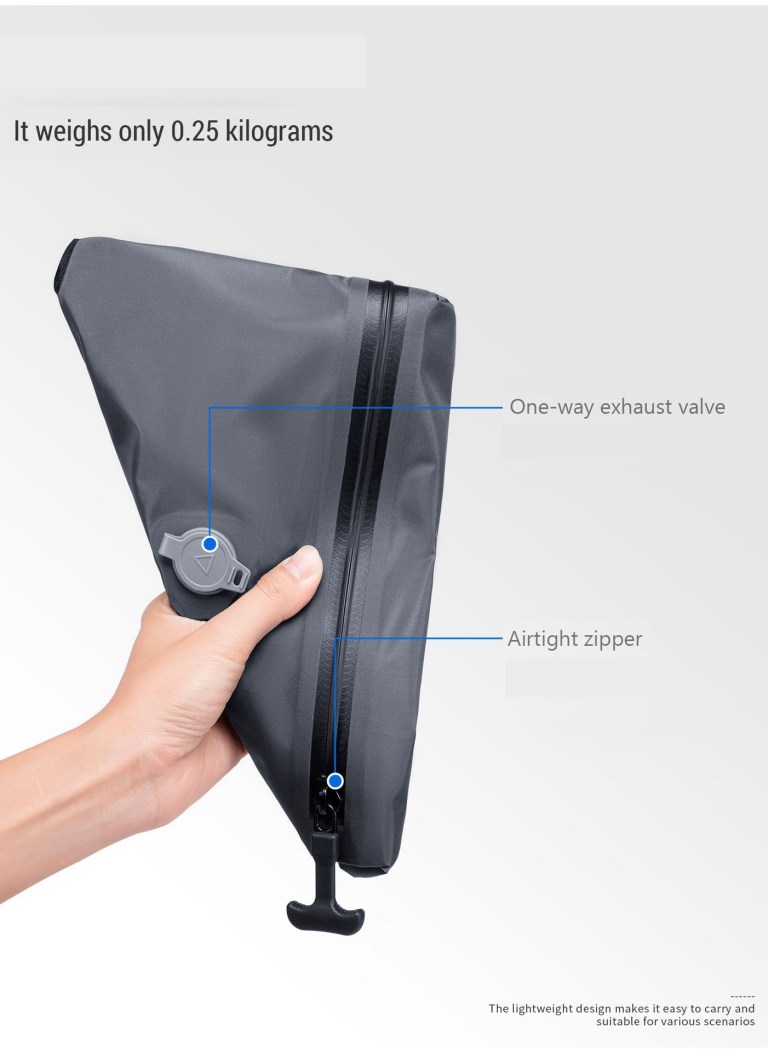
Triple-seal zipper closure: A double seal is standard; triple seal adds an extra layer of airlock security. This is especially important for travel, where bags are tossed, stacked, and compressed under other luggage weight.
One-way valve design: The valve should allow air to exit but prevent it from re-entering. High-quality valves use a silicone diaphragm that seals automatically when air pressure reverses. If you are sourcing for a brand, test the valve seal by pressing on a fully compressed bag — air should not leak back in.
Flat-bottom or gusseted design: Standard vacuum bags are rectangles that compress into irregular shapes. Gusseted bags (also called cube bags) have a flat bottom and rigid sides, allowing them to stack neatly in luggage without wasted space. These are the fastest-growing subcategory in travel vacuum bags for good reason.
Reusable construction: Single-use vacuum bags exist, but the market has moved strongly toward reusable. For travel, a bag should survive at least 20–30 compression cycles. This is directly tied to material quality — PA+TPU bags easily meet this standard, while thin PA+PE bags often fail sooner.
Size variety: Travel needs vary. A good set includes small bags (for underwear and socks), medium bags (for T-shirts and lightweight tops), and large bags (for sweaters, jackets, and jeans). Most B2B buyers look for sets that come in a coordinated pack with 3–6 pieces.
Sizing Guide: Which Vacuum Bag Size for Which Travel Item
Getting the size right is one of the most overlooked aspects of how to choose vacuum storage bags for travel. Here is a practical guide based on common garment types:
Small (30×40 cm / 12×16 in): Underwear, socks, swimwear, accessories. Best packed two pairs per bag for space efficiency.
Medium (40×50 cm / 16×20 in): T-shirts, lightweight blouses, shorts, casual pants. Fits 3–5 items depending on fabric thickness.
Large (50×70 cm / 20×28 in): Sweaters, hoodies, jeans, jackets. Compresses thick fabrics dramatically — a heavy winter sweater can go from 8 cm thick to under 2 cm.
Jumbo (60×80 cm / 24×32 in): Coats, parkas, bedding, multiple bulky items. Best for checked luggage or long trips.
A well-designed travel vacuum bag set includes at least three sizes, allowing the traveler to customize packing for each trip. Many brands now offer variety packs (2 small + 2 medium + 2 large) as their bestselling configuration.
Why Travel Brands Are Adding Vacuum Bags to Their Product Lines
From a B2B perspective, vacuum storage bags represent a high-margin accessory category with strong repeat purchase potential. Unlike luggage itself — which customers buy once every 3–5 years — compression bags are consumable accessories that travelers replace as they wear out or upgrade to better materials.
Private-label vacuum bags allow travel brands, luggage companies, and outdoor gear retailers to offer a complementary product that enhances the core travel experience. A customer who buys a new backpack from your brand is highly likely to buy a matching set of compression bags — if you offer them.
For brands sourcing from China, the key considerations are MOQ (typically 1,000–3,000 pieces per design), material specification (PA+TPU for premium lines, PA+PE for entry-level), and custom printing options (logo, color matching, packaging design). The custom printed vacuum storage bags market has grown steadily as more brands recognize the cross-sell opportunity.
How to Test Vacuum Storage Bag Quality Before Ordering
If you are sourcing vacuum storage bags for your brand, always request samples before placing a bulk order. Here is what to check:
Seal test: Fill the bag with air, seal it, and press down firmly. If air escapes within 10 seconds, the zipper seal is inadequate.
Compression test: Pack a standard garment (e.g., a cotton T-shirt or fleece jacket), compress the bag, and measure the final thickness. Compare across samples from different suppliers to benchmark performance.
Durability test: Compress and decompress the same bag 20 times. Check for seal weakening, valve failure, or material creasing. A quality travel vacuum bag should perform consistently through 30+ cycles.
Temperature test: Store the compressed bag at varying temperatures (e.g., in a car trunk during summer). Open after 24 hours and check if any air has re-entered. Temperature fluctuations can cause seal expansion and air leakage in lower-quality bags.
Valve test: The valve should close completely when not in use. Some bags use screw-cap valves, others use snap-shut designs. Both work, but screw-caps are generally more secure during travel.
Pairing Vacuum Storage Bags with the Right Luggage
Vacuum storage bags work best when paired with the right container. For travelers using backpacks and duffle bags — which have irregular internal shapes — cube-shaped vacuum bags are particularly effective. They eliminate dead space and keep the load balanced.
For brands that manufacture both luggage and accessories, offering matching vacuum bag sets creates a cohesive product ecosystem. Learn more about how we approach custom bag manufacturing from concept to delivery.
About SimiBag:
SimiBag is a vacuum storage bag and backpack OEM/ODM manufacturer based in Guangzhou, China. Since 2017, we have been producing custom travel bags, compression vaults, and luggage accessories for global B2B buyers. We specialize in PA+TPU vacuum bags with triple-seal technology. Contact us to discuss your next project.